Tyre Performance Guide
Tyre performance is a trade-off between grip, wear, noise, comfort, load capacity and heat resistance. No 4x4 tyre wins all of them. A road-biased tyre is quiet and long lasting, an aggressive tyre grips rock and mud, and an all-terrain sits in between. Choose by how you drive most weeks, not by the hardest trip you do once a year.
The six things that make a tyre perform
We judge a tyre on road grip, sand traction, rock and mud ability, noise, tread life and heat resistance. Our tyre types pages score each type on these. A mud-terrain scores highly on rock and mud but poorly on noise and life. A highway-terrain does the reverse. Understanding the trade-off helps you avoid paying for performance you will never use, and avoid a tyre that is unsafe for how you actually drive. Two other factors affect real-world results more than owners expect: pressure and age. A top-tier tyre at the wrong pressure performs worse than a mid-range tyre set correctly, and a ten-year-old premium tyre is a poorer choice than a new budget one. When you compare tyres, compare them as they will be on your vehicle in normal use.
Grip on tarmac and in the wet
Grip depends on the compound, the tread pattern and tread depth. Wide, solid blocks give stability at speed, while deep grooves clear water. Wet grip matters in the UAE more than people expect, because rain is rare, and the first shower lifts oil and dust from the surface, creating a slick film. Braking distances are longer with aggressive tyres, and they lengthen as tread wears. Highway-terrain and touring tyres usually brake shortest in the wet. If you drive fast on E311, prioritise a tyre with strong wet braking. Tread depth has a large effect on wet grip. As the tread wears down, the tyre has less capacity to clear water, and the risk of aquaplaning rises, especially on the long flat sections of E611 and E11 where standing water forms after rain. Replace tyres before they are close to the limit if you do a lot of highway driving, and do not rely on a single measurement, because wear is often uneven.
Traction on sand, rock and mud
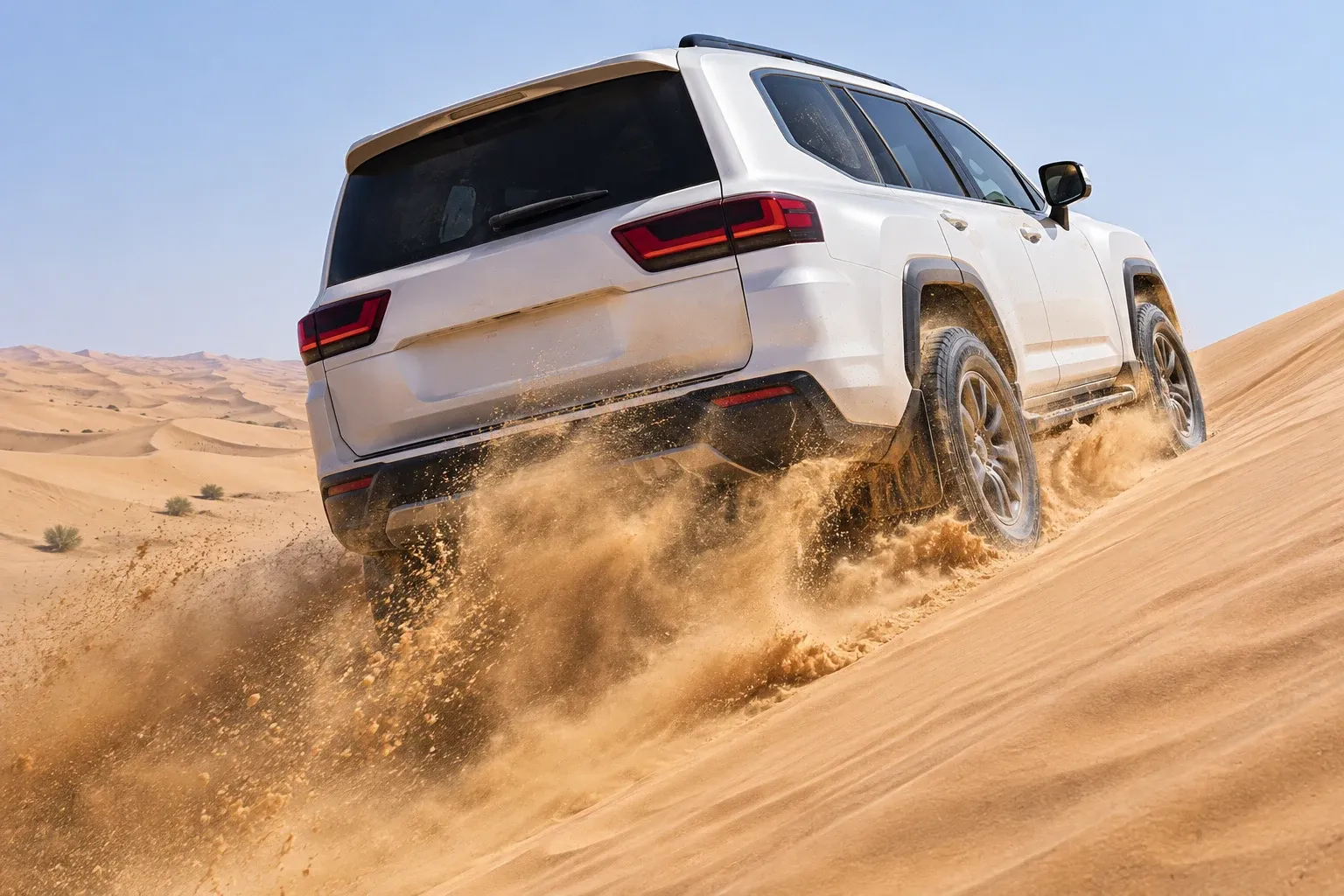
Sand needs flotation: a wide footprint at lowered pressure, with a sidewall that flexes safely. Rock needs strong, cut-resistant sidewalls and shoulder lugs. Mud needs open tread that clears itself. An all-terrain tyre handles dunes well. A mud-terrain clears mud and bites rock, but is not automatically better on sand. Match the tyre to the surface you drive most, and set pressure for the ground. A well-judged pressure often matters more than the tyre model. Do not forget the vehicle itself. Weight, gearing, traction control settings and driver technique all change what the tyre can do. A skilled driver on a modest tyre at the right pressure often outperforms a poor driver on an aggressive one. On sand, keep momentum, avoid wheel spin and use the lowest gear that keeps the revs steady, because spinning digs the tyre in and heats it quickly.
Noise, comfort and fuel use
Noise comes from tread blocks hitting the road and from air trapped in grooves. Aggressive patterns produce more hum, and noise rises as the tyre wears. Comfort depends on sidewall stiffness, and LT tyres ride firmer than passenger tyres, especially unladen. Rolling resistance affects fuel use, and heavy mud-terrains cost more to run than highway tyres. If you commute daily, those costs add up. If you drive 30 minutes on E11 each morning, the difference between a quiet tyre and a loud one is noticeable. When we compare noise, we mean both the sound in the cabin and how it changes over time. Some aggressive tyres are acceptable when new and become tiresome once the blocks cup. Rotation, alignment and correct pressure slow that. If you notice a rising hum at constant speed, have the tyres checked for uneven wear before you assume the road surface is to blame.
Heat, load and speed rating
Heat is the main killer of tyres in the UAE. A tyre that is overloaded or underinflated flexes too much, and the friction heats the rubber until the layers separate. Load index and speed rating describe what the tyre can cope with, and you should never go below the original. Towing, roof racks and full seven-seat loads raise demands. Read our tyre size guide for what the numbers mean. Cheap tyres are not always poor, but check their ratings and build date. Heat damage builds up. A tyre that has run low in summer several times may look fine but carry internal damage that shortens its life. That is one reason we recommend an inspection after any incident of heavy under-inflation, a long drive on a soft tyre or an impact with a kerb or pothole at speed.
Tread life and what shortens it
Tread life depends on compound, driving style and maintenance. Under-inflation, misalignment, worn suspension and missed rotations wear tyres faster. Hot tarmac and hard braking also raise wear. Look for uneven wear as an early warning, and read our blog on uneven tyre wear patterns. A wheel alignment from AED 180 per vehicle can pay for itself by protecting a new set. Remember that age limits life as well as tread: makers advise inspection from 5 years and replacement by 10. There is no universal kilometre figure we can promise, because life depends on vehicle weight, tyre type and road. What we can say is that an owner who checks pressure, rotates and aligns will usually see even wear and a longer service life than one who does not. Keep a note of the tread depth at each service, so you can see the trend rather than guess.
Matching tyre to driving pattern
For mostly city and highway driving, choose highway-terrain or touring. For a mix of road and desert, pick all-terrain. For mountain trails and rocks, consider rugged-terrain or mud-terrain. For towing and loads, choose LT tyres with the right load range. If you cannot decide, tell us your weekly kilometres, your vehicle and where you drive, and we will tell you plainly when a cheaper tyre is fine and when an aggressive one is the wrong choice. Many owners choose by appearance first and use second. A bold mud-terrain looks good, but if your driving is E11 and a mall car park, you pay for it in noise and wear. The reverse also happens, where a highway tyre is fitted to a vehicle that goes to the dunes monthly, and recoveries become frequent. Honest planning saves money and avoids stuck-vehicle days.
Balance, alignment and rotation
Even a good tyre performs badly when the wheels are out of balance or alignment. Vibration at 100 to 120 km/h usually points to balance, and a car that pulls or wears one edge points to alignment. Our wheel balancing is from AED 120 for four wheels, and tyre rotation from AED 100 per vehicle. Regular checks keep performance close to what the tyre was designed for, and they are cheaper than replacing a set early. Make these part of every tyre change. New tyres on a misaligned vehicle will wear badly within a few thousand kilometres, and a new tyre on an unbalanced wheel will vibrate from the first drive. Ask us for a combined fitting, balancing and alignment visit, and we will check pressure, valves and the spare at the same time.
Related guides
Frequently asked questions
Which tyre type has the best grip?
It depends on the surface. Highway-terrain grips best on tarmac, mud-terrain on rock and mud, and all-terrain gives a balance.
Are expensive tyres worth it?
Often for wet grip, noise and life, but a cheaper tyre can be fine for light use. We tell you honestly which suits your driving.
Why does my tyre get noisier over time?
Tread blocks wear unevenly, especially with missed rotations or misalignment. Noise usually rises as the tyre wears.
Do all-terrain tyres use more fuel?
Slightly more than road tyres, because of higher rolling resistance and weight.
How does heat affect tyre performance?
Heat softens rubber, raises pressure and speeds up ageing. Underinflation and overload make it worse.
Should I upgrade to a more aggressive tyre?
Only if you use the extra grip. Otherwise you pay with noise, wear and road manners.
Send us your tyre size or car model
We reply with options and a starting price. Pay by cash, card, Tabby or Tamara.