Tyre Pressure Guide
Set road pressure to the figure on your door placard, measured cold, and check it monthly. In UAE heat, pressure rises about 1 psi for every 5 to 6 degrees Celsius, so do not release air from hot tyres. For sand, 15 to 20 psi is a common starting point, and you must reinflate before returning to tarmac.
Why pressure matters more here
Correct pressure keeps the tyre flat on the road, spreads load evenly and controls heat. Too low, and the sidewalls flex and overheat, which is a leading reason tyres fail in summer on E11 and E311. Too high, and the centre of the tread wears, the ride is harsh and grip drops, especially on the first rain after a dry spell. In UAE conditions of 45 degree air and 60 degree road surfaces, small errors have bigger effects than in cooler countries. Pressure also changes fuel use and braking distance. Fuel use is also affected. A set of tyres 6 psi under pressure can raise rolling resistance noticeably, and on a thirsty V8 the extra fuel adds up over a month of driving between Dubai and Abu Dhabi. Correct pressure also protects the rims, since an under-inflated tyre lets the rim touch the road surface harder when you hit a pothole or a speed hump.
Where to find the right figure
The vehicle maker sets the correct road pressure, shown on a placard in the driver door frame, on the fuel flap or in the owner manual. This is the authority for road pressure, and it often lists separate figures for front and rear, and for light and full loads. Do not use the maximum figure on the tyre sidewall as your normal pressure. That is the highest the tyre can take, not the recommended level. Commonly, large SUVs sit in the low to mid 30s psi, though trim and tyre type affect this, so always check your own vehicle. Some placards list a higher pressure for sustained high speed or full load. If you drive long stretches at 120 km/h in summer, follow that figure rather than the lower comfort one. If you have changed tyre size or type, the original placard may no longer be exact, and the tyre maker's load and pressure tables apply. We can work this out with you using the load index of your new tyres.
Measure cold, and why heat matters
Cold means the car has been parked for at least three hours or driven less than a couple of kilometres. Pressure rises about 1 psi for every 5 to 6 degrees Celsius, and driving adds more. A tyre set at 35 psi at dawn may read 40 psi or more after an hour of highway in July. That is normal, and you should not bleed it down. If you must check a hot tyre, expect a higher reading and compare against your cold figure. We can do this with a tyre pressure check from AED 30 per vehicle. If you fill tyres at a fuel station after a drive, the reading is hot and the tyre will end up under-inflated once it cools. Add a couple of psi at the pump only if you plan to drive straight back and then correct at home in the morning. A better habit is to carry a small compressor and check at home before you leave, when the tyres are cold and the reading is true.
Converting bar, kPa and psi
Many placards and pumps use bar or kPa. One bar equals about 14.5 psi, so 2.4 bar is about 35 psi, and 240 kPa is also about 35 psi. Check that your gauge and compressor use the same unit before you set pressure. Cheap gauges can read several psi wrong, so a good digital or dial gauge pays for itself. Fuel station compressors vary too, so verify with your own gauge. Heavy trucks often need much higher pressure, such as 50 to 65 psi for LT tyres under load, so read the placard. For quick reference, 2.0 bar is about 29 psi, 2.2 bar about 32 psi, 2.5 bar about 36 psi and 3.0 bar about 44 psi. Gauges can show different units on each scale, so read the correct one. If your TPMS display shows kPa, convert before you add air. Keep a note of your correct front, rear and loaded figures in the glove box so you do not need to look them up each time.
Loads, towing and spares
A loaded SUV or pickup needs higher pressure, particularly at the rear. Follow the loaded figure in the manual when you carry seven passengers, a roof box or camping gear. When towing, the rear tyres carry tongue weight, and underinflation causes heat. Do not forget the spare. A spare left for years loses pressure and can be unusable when you need it, so check it monthly and note its date code. Many pickups carry the spare under the bed, where it is easy to ignore. If you carry a roof box or a rooftop tent, the extra weight raises the vehicle centre of gravity and pushes more load onto the tyres. Increase pressure to the loaded figure and drive more gently on slip roads and roundabouts. After a long trip with a full load, check for uneven wear, since a few weeks at the wrong pressure can leave a visible pattern on the tread.
Pressure for sand and dunes
Lower pressure lengthens the tyre footprint, so the vehicle floats rather than digs. A common starting point is 15 to 20 psi, and you should go lower only with care and at low speed, because very low pressure risks the tyre leaving the rim. Smooth throttle, gentle steering and a steady pace matter more than the exact number. Sand pressures are starting points, and heavy vehicles, wide tyres and firm sand all change the answer. Read our blog on dune pressures for more detail.
Reinflate before you drive on tarmac
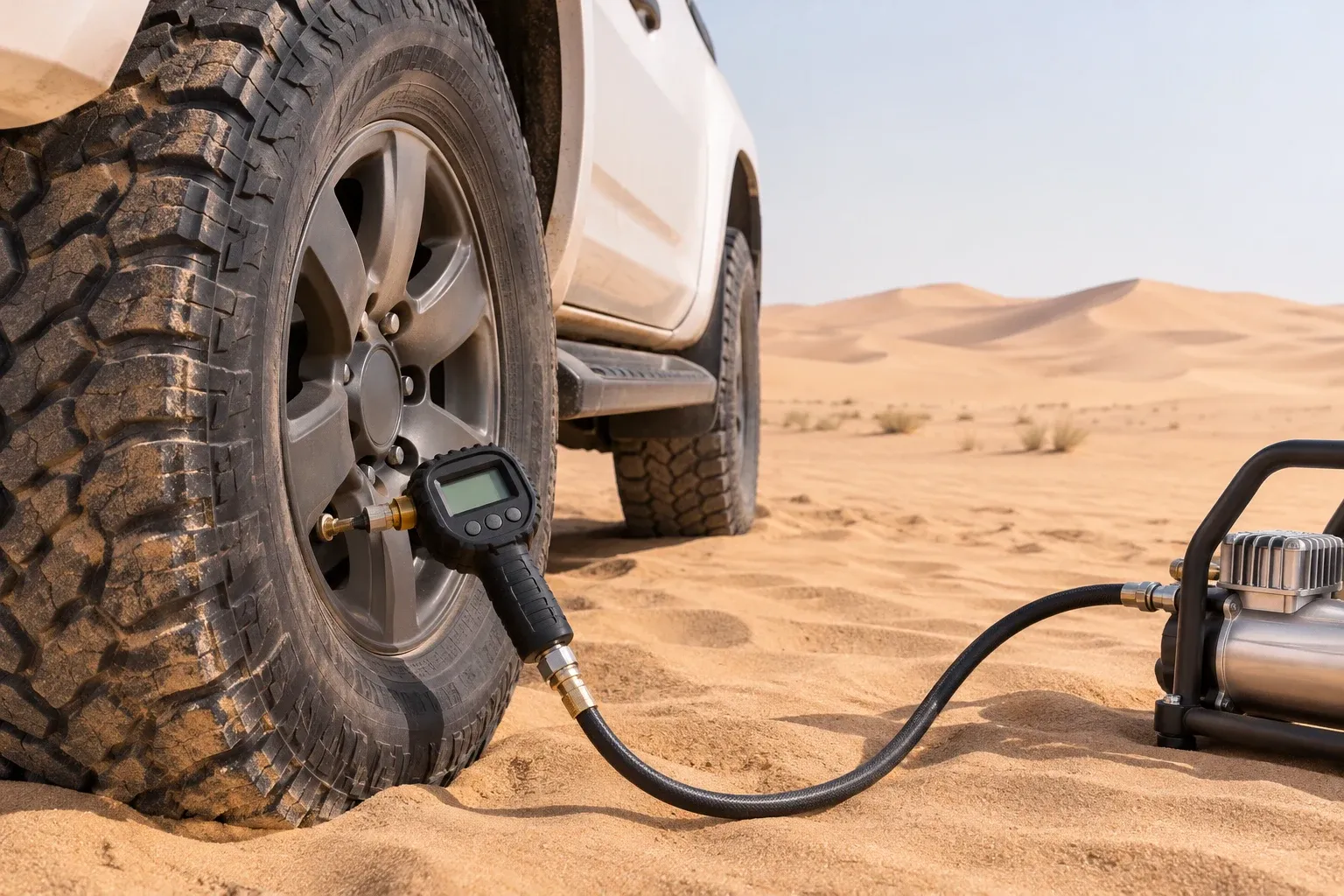
This is the most important rule. Driving at highway speed on 15 psi overheats the tyre within minutes, and a blowout at 120 km/h is dangerous. Carry a 12V compressor and gauge, and stop at the edge of the sand to reinflate before you rejoin the road. If sand gets between the tyre and rim, the bead may leak, as explained in our blog on sand in the tyre bead. Our desert tyre prep visit from AED 150 per vehicle checks tyres, valves and kit before a trip.
TPMS warnings and what to do
Tyre pressure monitoring systems warn you when a tyre drops below a set threshold, often around 20 to 25 per cent under placard pressure. Do not ignore the light. Check all four tyres and the spare with a gauge, and look for nails or damage. A light that flashes then stays on can mean a faulty sensor, and sensors have limited battery life. We replace and reprogram TPMS sensors from AED 190 per sensor. After changing tyres, the system may need a reset or relearn. Remember that TPMS is a warning, not a substitute for a gauge. The system often waits until pressure is well below the placard figure before it lights, and it may not show a slow rise in pressure. Keep checking by hand each month, and if a sensor fails or the light stays on after you set the right pressure, bring the vehicle in for a scan.
Related guides
Frequently asked questions
What is the correct tyre pressure for my 4x4?
Use the figure on your door placard. It is the authority for road pressure, and it is measured cold.
Should I lower pressure in summer?
No. Heat raises pressure by itself. Set pressure cold to the placard figure and do not release air from hot tyres.
What is 240 kPa in psi?
About 35 psi. One bar is roughly 14.5 psi.
What pressure should I use on sand?
A common starting point is 15 to 20 psi. Lower only with care and at low speed, and reinflate before returning to tarmac.
How often should I check tyre pressure?
At least monthly and before long trips. Check the spare too.
Does nitrogen help in UAE heat?
It can hold pressure slightly more steadily, but correct pressure and regular checks matter far more than the gas.
Why does my TPMS light come on in the morning?
Cooler air lowers pressure, and a tyre close to the threshold can trigger the light. Check and top up cold.
Send us your tyre size or car model
We reply with options and a starting price. Pay by cash, card, Tabby or Tamara.