Tyre Care Guide
The most useful tyre care in the UAE is simple: check pressure cold every month, rotate on schedule, keep alignment correct, park out of the sun when you can, and replace tyres on age as well as tread. Makers advise inspection from 5 years and replacement by 10, and UAE heat often shortens this.
Check pressure monthly
Pressure is the biggest factor you control. Check all four tyres and the spare once a month, early in the morning before the car has moved. Use the door placard figure, which is the authority for road pressure. Pressure rises about 1 psi per 5 to 6 degrees Celsius, so afternoon readings are higher and should not be bled down. A good gauge costs little. Our tyre pressure check is from AED 30 per vehicle if you want a second opinion. See the tyre pressure guide for loads, towing and sand. Write the date of each check in your phone, so the habit sticks. Keep the cap on each valve, since caps keep dust and sand out of the valve core. A leaking valve core is cheap to replace and a frequent cause of slow pressure loss. If you see a TPMS warning, check immediately rather than waiting for the next scheduled visit.
Rotate on a schedule
Tyres wear differently on each axle, and on a 4x4 the front wears at the shoulders while the rear can carry heavy loads. Rotating moves each tyre to another position, so wear evens out and the set lasts longer. Many owners rotate at every service, and we offer tyre rotation from AED 100 per vehicle. Follow the pattern in your owner manual, since some tyres are directional and some vehicles have different front and rear sizes. Rotation also lets us spot cuts, bulges and uneven wear early. If your vehicle has staggered tyre sizes, such as wider rear tyres on some luxury SUVs, rotation is limited to side-to-side swaps, and we will explain what your vehicle allows. Always recheck pressure after a rotation. Keep directional tyres on the same side of the vehicle.
Keep alignment and balance right
Potholes, kerb strikes, lifted suspensions and heavy loads all push alignment off. A pull to one side, a steering wheel that sits off-centre or wear on one edge are signs. A 4x4 wheel alignment from AED 180 per vehicle protects a set of tyres worth thousands. After any suspension change or tyre upgrade, align again. Balance matters too. A shake at 100 to 120 km/h suggests it is time for wheel balancing, from AED 120 for four wheels. Lifted vehicles, bigger tyres and heavy bumpers all change alignment angles, so alignment after any modification is important. Have the vehicle aligned with its normal load, with full fuel and without a roof tent or bulky gear inside, so the setting matches normal driving. Check the steering wheel position after the work and on the road.
Beat the heat
Heat ages rubber, raises pressure and increases blowout risk. Park in shade or in a basement when you can, and avoid leaving a vehicle in full sun for weeks. Do not overload, and do not drive on under-inflated tyres in summer. Read our blog on why tyres burst in UAE summer and the summer tyre care guide. Check the sidewalls for fine cracks, which show UV and heat damage, and check the date code on all tyres including the spare. Pay particular attention on long summer drives to Abu Dhabi, Al Ain or Fujairah. Stop occasionally, feel the tyres with the back of your hand, and look for any soft tyre. If you can, travel in the cooler hours, and avoid carrying extra weight beyond the load rating. Tyres that are close to their age limit are better replaced before the summer season begins than during it.
Prepare for desert trips
Before a dune weekend at Al Qudra, Lisaili or Liwa, check tread, sidewalls and valve caps, and make sure the spare is inflated and in date. Carry a 12V compressor, a gauge, a deflator, tracks and a shovel. Start around 15 to 20 psi on sand, lower only with care and low speed, and always reinflate before returning to tarmac. Our desert tyre prep is from AED 150 per vehicle. Read the blog on a recovery kit checklist for the full list. Never go alone to remote areas without telling someone your route and expected return time. Bring water, a first aid kit and a charged phone. Check the weather, since summer sand can be hot enough to stress a soft tyre. A short check before the trip is also a chance to confirm your spare and jack work.
After the trip
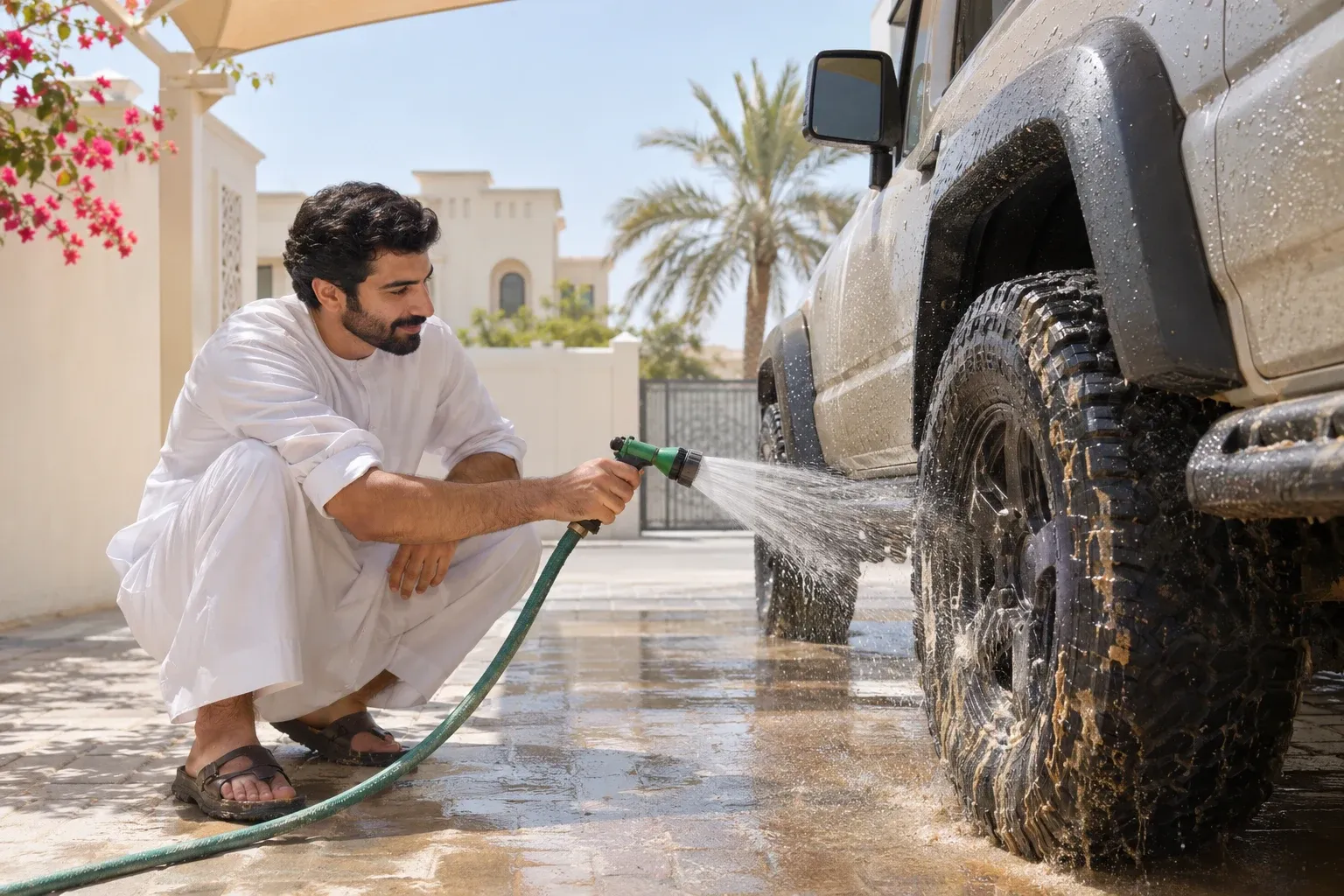
Rinse sand and salt from wheels and brake areas, and look for stones lodged in the tread. Check for slow leaks over the next days, because sand under the bead can cause a slow loss of pressure. Inspect for sidewall cuts and for a bent rim, especially after rocky wadi runs near Hatta. Re-check pressure cold the next morning. If a tyre looks suspicious, have a tyre inspection from AED 50 per vehicle. A few minutes after the trip often saves a roadside call later. Do not forget the spare and the recovery gear. Rinse and dry straps and boards, and recharge your compressor battery pack. If you pulled a stuck vehicle out, check the tow points and your own tyres for stress. We offer mobile service in Dubai, Abu Dhabi and Sharjah, so if a problem appears on Sunday evening, we can come to you rather than leave you waiting.
Know when to replace
Replace a tyre when the tread is low, when there is damage that cannot be repaired, or when it is old. UAE police can fine drivers for worn or unsafe tyres, and worn tread is far less safe in rain. Check the date code, and replace by 10 years at most, sooner if the rubber is cracked. Use our blog on when to replace all four tyres and how long 4x4 tyres last. Never mix very different tread depths on a full-time 4x4 without advice. A good habit is to measure tread depth at each service and replace when tread is clearly low, well before it is bald. Look at the wear bars, which are small raised ridges in the tread grooves. If the surface of the tread is level with them, the tyre is at its limit. Consider replacing all four together on a permanent 4x4 to protect the drivetrain.
Spares, storage and what to avoid
Check your spare as carefully as the rest. If you store spare tyres or a seasonal set, keep them clean, cool, dark and upright or stacked, away from motors and sun. Avoid tyre dressings that leave a shiny film and dry out rubber. Do not fit mismatched tyres on one axle, do not drive with a flat to reach a workshop, and do not repair sidewalls. For a service from our team, see our services page or call us for a mobile visit anywhere in Dubai, Abu Dhabi and Sharjah, 24 hours a day. Keep a printed note of your tyre size, pressure figures and date codes in the glove box. It helps any technician help you quickly, and it shows when the next change is due. If you change tyres before a long trip abroad, such as to Oman, plan the fitting a few days ahead so there is time to check balance and alignment.
Related guides
Frequently asked questions
How often should I check my tyre pressure?
At least monthly, and before long trips or desert runs. Check when cold and use the door placard figure.
How often should I rotate my tyres?
Many owners rotate at each service. Follow your owner manual and have us check wear patterns.
How long do tyres last in the UAE?
It depends on type, driving and care. Age matters as much as tread: makers advise inspection from 5 years and replacement by 10, and UAE heat often shortens this.
Should I park in the shade to protect tyres?
Yes, when you can. Sun and heat speed up ageing and cracking.
Do I need to check the spare tyre?
Yes. Check pressure monthly and the date code, since spares age even when unused.
What should I do after a desert trip?
Reinflate, rinse the wheels, check for cuts and leaks, and re-check pressure the next morning.
Can tyres be repaired in the desert?
Small tread punctures can be plugged as a temporary fix with a kit, then properly repaired at a workshop. Never repair sidewalls.
Send us your tyre size or car model
We reply with options and a starting price. Pay by cash, card, Tabby or Tamara.