Tyre Damage Guide
Find your symptom, identify the likely cause, and check whether it can be repaired. A puncture in the central tread can often be repaired. A sidewall bulge, cut or shoulder puncture cannot be repaired, and the tyre must be replaced. If you are unsure, stop driving and have the tyre inspected.
How to use this guide
Each section below follows the same order: the symptom, the likely cause, whether the tyre is repairable and what to do next. Never repair a sidewall or shoulder puncture, and do not repair a tyre run flat for any distance without internal inspection. We can inspect a tyre for AED 50 per vehicle with a tyre inspection, and mobile vans can reach you in Dubai, Abu Dhabi and Sharjah at any hour. When in doubt, replace, because a tyre is the only part of the vehicle touching the road. A quick rule applies to every case: if the tyre is losing air, bulging, cut deeply, cracked or vibrating, do not treat it as normal. Slow down, move to a safe place and get it checked. Drivers often wait for a convenient moment, and tyres tend to fail at the least convenient one, which in the UAE often means a hot afternoon on a fast road with no hard shoulder.
Symptom: nail or screw in the tread
Cause: construction debris and roadside metal, which is common on routes such as Al Ain Road and around Al Quoz. Repairable: often yes, if the object is in the central tread, the hole is small and the tyre has not been driven flat. A proper repair needs the tyre off the rim, a plug and patch from inside, and an inspection of the inner liner. A plug alone from outside is not a lasting repair. What to do: leave the nail in, drive gently to a workshop or call us. Our puncture repair starts from AED 70 per tyre, and mobile tyre fitting from AED 150 per call-out. A repair is only suitable when the damage is small, is in the central tread area and does not touch the shoulder. Multiple punctures close together, or a hole that has been enlarged by driving, usually mean replacement. Keep a note of the date of any repair, and avoid heavy loads and long high-speed runs until the tyre has been checked.
Symptom: bulge or bubble on the sidewall
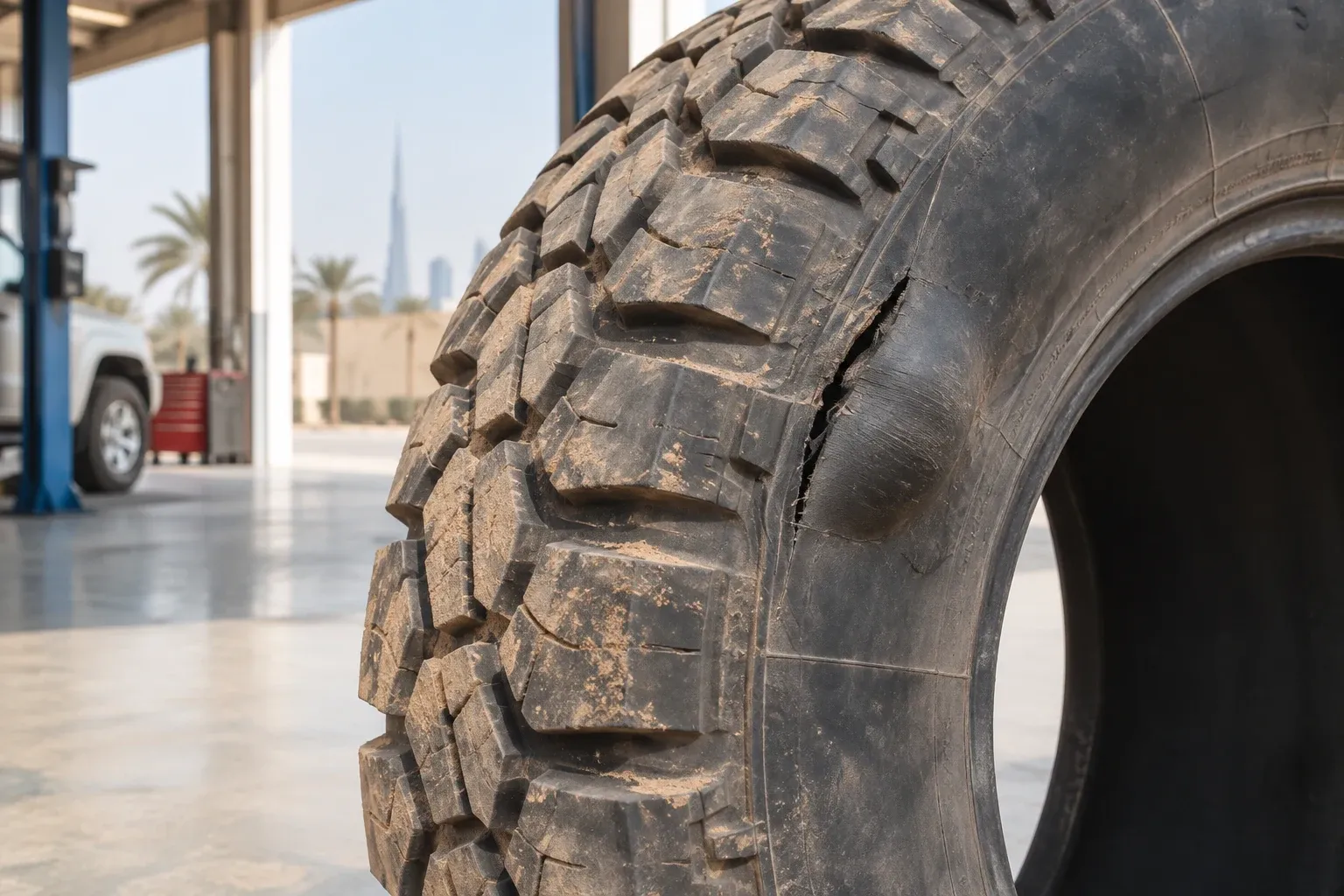
Cause: an impact from a pothole, kerb or rock has broken internal cords, and air pressure pushes the rubber outwards. Repairable: no. A bulge means the tyre structure has failed, and it can burst without warning, particularly in heat and at speed. What to do: stop, avoid highways, and fit the spare or call us. Replace the tyre, and consider replacing its pair on the same axle if it is similar in age. Check the rim for bends as well, since the impact that damaged the tyre may have damaged the wheel. Bulges can appear slowly or all at once. Look for them whenever you wash the car or check pressure, running a hand gently over the sidewall as well as looking. A blister in the tread face is also a failure of internal bonding, and it is likewise not repairable. If you hit something hard, check the tyre even if nothing seems wrong, because damage can show hours or days later.
Symptom: cuts and gouges
Cause: sharp rock, wadi stones or a kerb strike, common on rough tracks at Hatta and in Ras Al Khaimah. Repairable: shallow tread scuffs are usually fine. A cut that exposes cords, or any cut in the sidewall or shoulder, is not repairable. What to do: look closely, and if you see fabric or steel, replace the tyre. Aggressive and LT tyres resist cuts better. If you drive rocky tracks, reduce speed, avoid sharp stones and consider rugged-terrain tyres. Also check the rim for damage. Deep gouges in the tread blocks of off-road tyres are common and often cosmetic. The test is depth and position. If you can see the cord or fabric, or if the cut runs along the shoulder, replace the tyre. After a rocky drive, check the inside edge as well as the outside, since the inner sidewall is hard to see and often takes the hit.
Symptom: cracking and dry rot
Cause: heat, sun and age. Fine cracks in the sidewall or between tread blocks appear in tyres parked outside and in older spare tyres. Repairable: no, and cracks are not a puncture to patch. What to do: check the date code, because makers advise inspection from 5 years and replacement by 10, and UAE heat often shortens that. Deep cracks mean replacement now. Shallow surface crazing may be monitored, but have us inspect it. Parking in shade, using tyre covers during long stays and avoiding silicone dressings that dry rubber can slow ageing. See our tyre care guide. Cracking often shows first on the spare, and on vehicles parked for long periods during summer travel. If your car sits for weeks, move it slightly now and then, because tyres left in one spot flat-spot and age unevenly. Ask us to check any tyre you are unsure about. A quick look by a technician is cheaper than a blowout on E311.
Symptom: uneven wear
Cause: wear on both shoulders means under-inflation, wear in the centre means over-inflation, wear on one edge means alignment, scalloped or cupped patches mean worn suspension or poor balance, and feathering points to toe misalignment. Repairable: the tyre cannot be reshaped, but the cause can be fixed. What to do: correct pressure, then book a wheel alignment from AED 180 and check suspension. Rotate tyres regularly. Read the detailed blog on uneven tyre wear patterns. Replace tyres when tread is low or uneven wear is severe. Look at the tyre in good light and run your hand across the tread, feeling for steps or feathering. Inside-edge wear often shows a vehicle that has been lifted or overloaded. If a new set wears unevenly within a few months, return for an alignment check rather than waiting for the next service, because the damage grows quickly.
Symptom: vibration, pulling or a shaking steering wheel
Cause: a vibration at highway speed usually means an unbalanced wheel, a bent rim, a tyre with internal damage or a lost balance weight. Pulling to one side points to alignment, uneven pressure or a tyre problem such as belt separation. Repairable: balance and alignment are simple fixes, but a damaged tyre or bent rim is not. What to do: get wheel balancing from AED 120 for four wheels, inspect the tyre for bulges, and check the rim. If the rim is bent, see our blog on bent off-road rims and our rim repair service. Vibration that comes and goes with speed is a tyre or wheel issue, while vibration only under braking points to the brake discs. A steering wheel that shakes at 80 to 100 km/h often means front balance, and one that shakes only at higher speed may be rear balance felt through the seat. A mechanic can separate these quickly with a road test.
Symptom: slow leak or a tyre that loses air overnight
Cause: a small puncture, a leaking valve stem, a corroded rim bead seat, a bent rim or sand lodged under the bead after a desert trip. Repairable: usually yes. A new valve costs little, a rim can be cleaned or repaired, and a small tread puncture can be patched. What to do: spray soapy water on the tread, valve and rim edge to find bubbles, or let us do it. Do not keep topping up and ignoring it, because driving underinflated damages the tyre. See sand in the tyre bead if you were recently off-road. Leaks after a desert trip are common, because fine sand works under the bead and keeps it from sealing. Cleaning the bead seat and refitting the tyre usually fixes this. Corrosion on alloy or steel wheels causes slow leaks as well, and a bead seat that is pitted may need cleaning or professional repair.
Symptom: sudden flat, blowout or tyre driven flat
Cause: a large puncture, heat failure, impact or running low on pressure at high speed. Repairable: usually not, if the tyre has been driven flat for any distance, because the sidewall is crushed and the inner liner damaged. This is true for run-flats too, which need internal inspection. What to do: hold the wheel firmly, ease off the throttle, avoid hard braking, and pull over safely. Call us for a flat tyre call-out from AED 120, or fit the spare. Check the spare pressure regularly, so it is ready when you need it. We can also supply a spare tyre service from AED 90. After the event, do not assume the tyre is only flat. Check the rim edge for bends, the valve for damage and the TPMS sensor for impact. A tyre that has been driven flat often has a ring of damage on the inner sidewall that cannot be seen from outside. We will take the tyre off and check inside before offering any repair.
Related guides
Frequently asked questions
Can I repair a sidewall puncture?
No. Sidewall and shoulder punctures cannot be safely repaired, and the tyre must be replaced.
Is a bulge on the tyre dangerous?
Yes. It means the internal cords have broken and the tyre can fail suddenly. Stop driving on it and replace it.
Can I drive on a flat tyre to the workshop?
Not safely. Even a short distance can ruin the tyre and damage the rim. Fit the spare or call a mobile service.
Can a tyre with a nail be repaired?
Often, if the nail is in the central tread and the tyre was not driven flat. It needs a proper plug and patch from inside.
Why does my steering wheel shake on the highway?
Commonly wheel imbalance, a bent rim or tyre damage. Have it balanced and inspected.
What causes cracks on tyre sidewalls?
Age, sun and heat. Cracking is a sign to check the date code and have the tyre inspected.
Can run-flat tyres be repaired?
Only after an internal inspection, and many makers advise replacement. A run-flat driven flat should not be reused without inspection.
How much does puncture repair cost?
Puncture repair at our workshop starts from AED 70 per tyre, subject to the tyre being repairable.
Send us your tyre size or car model
We reply with options and a starting price. Pay by cash, card, Tabby or Tamara.