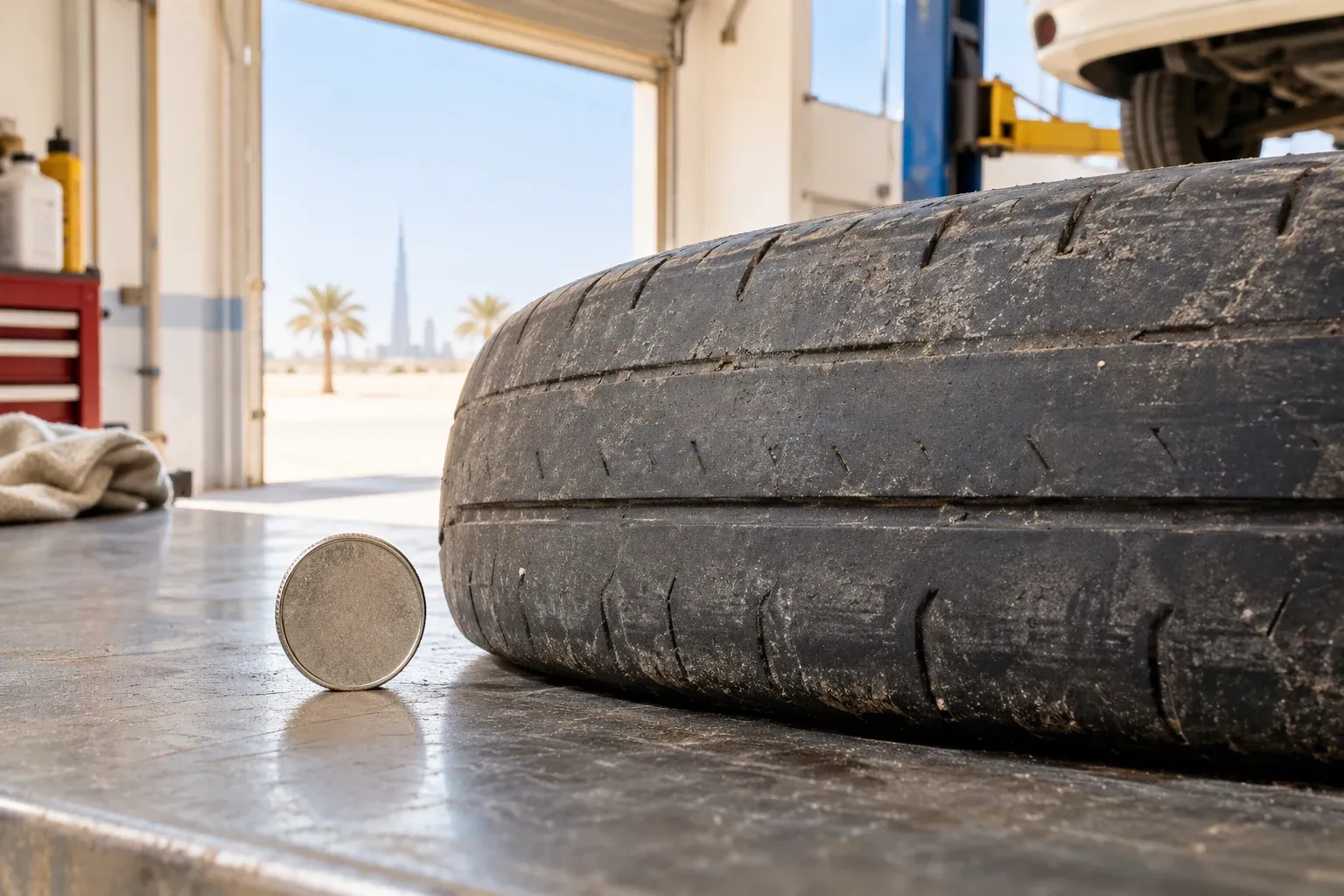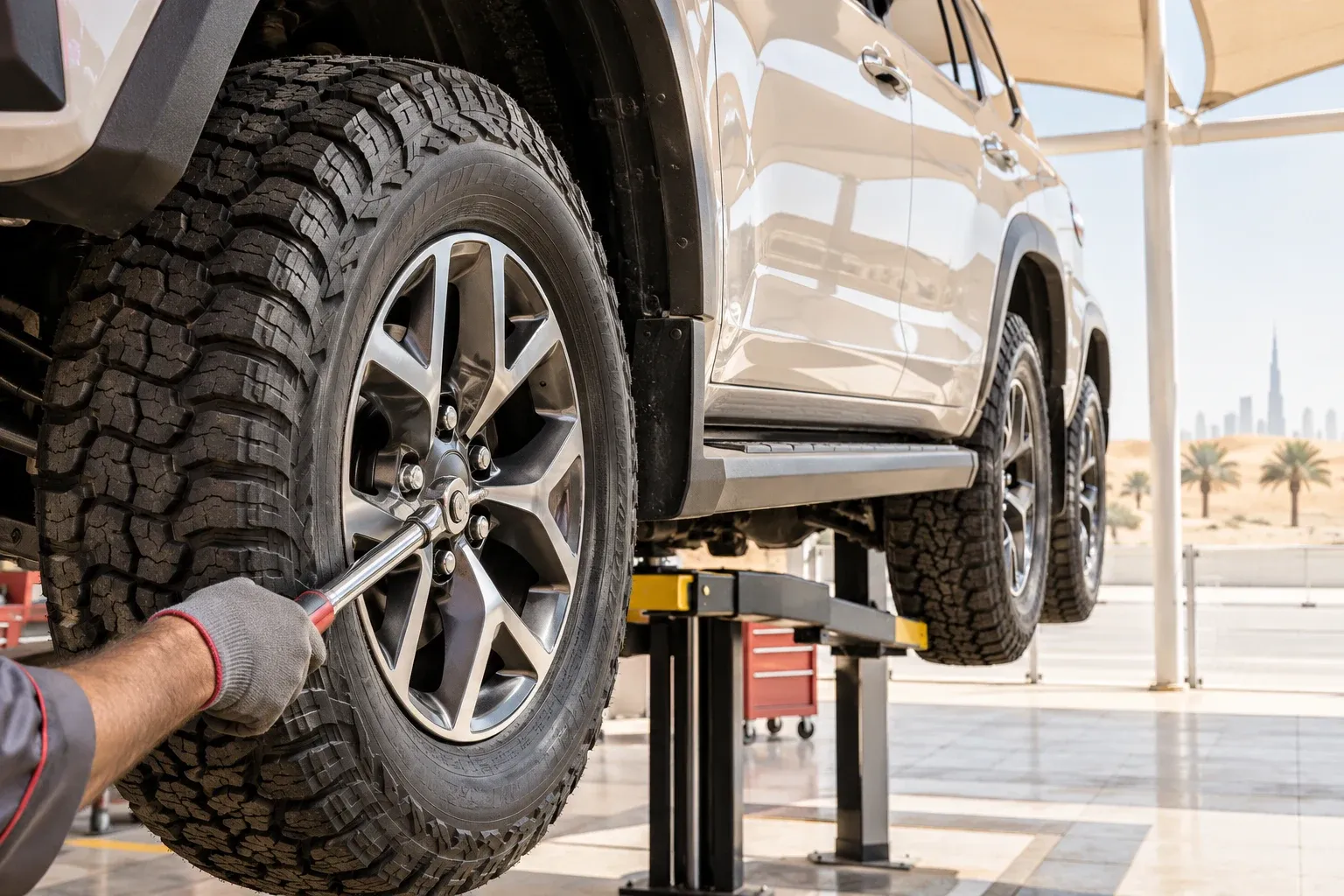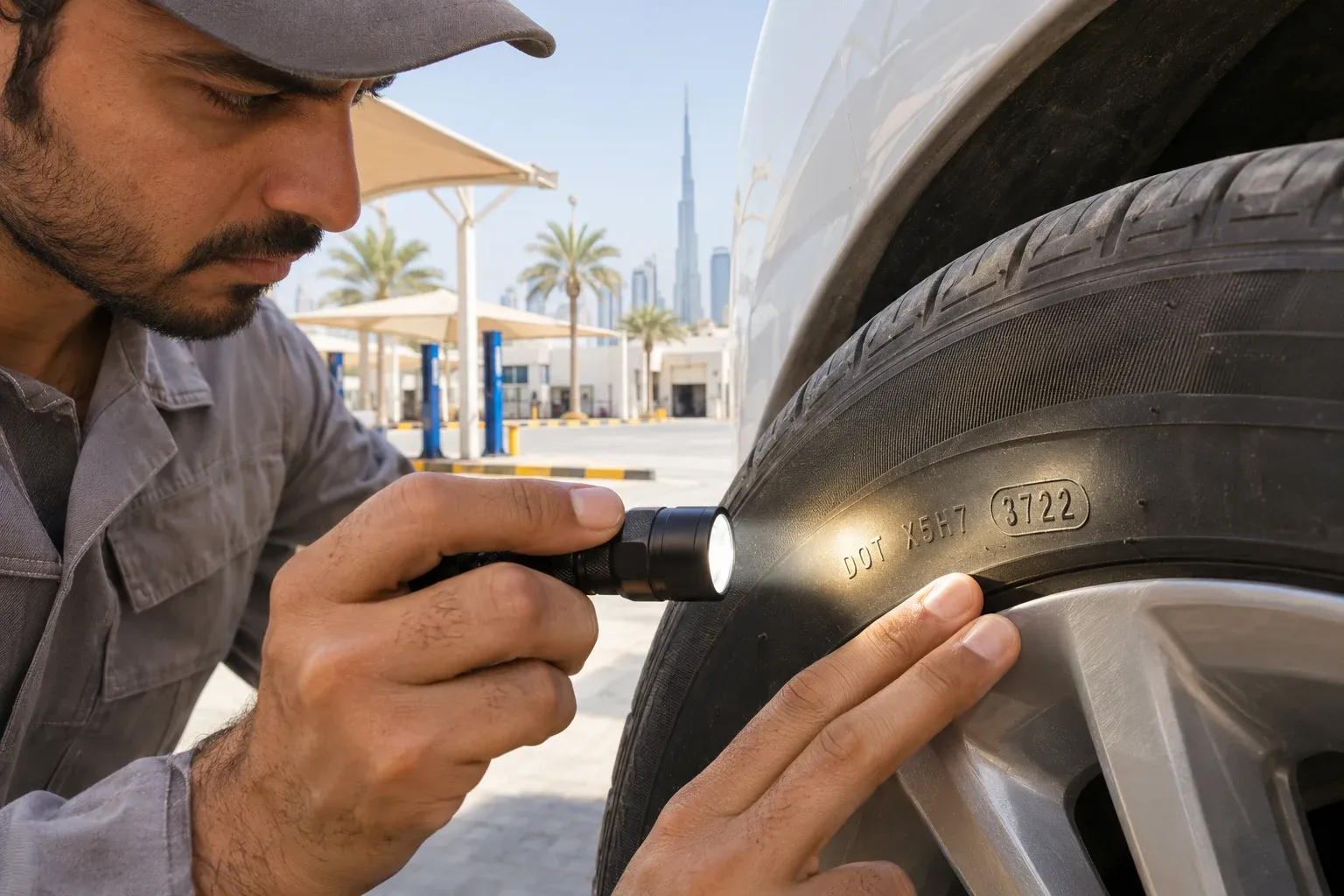
Find the letters DOT on the sidewall, then read the last four digits. The first two are the week of manufacture and the last two are the year. So 3521 means week 35 of 2021. Subtract that from today’s date and you have the tyre’s age.
It takes a minute and it tells you something no tread gauge can. Here is how to do it properly, and what to do with the answer.
Finding the code
Walk around the tyre and look at the sidewall for the letters DOT, followed by a string of letters and numbers. The code is usually inside a slightly raised oval. You might find it on the outside face, but many tyres carry the full code only on the inside sidewall, facing the vehicle.
Use your phone torch. The moulding is the same black as the rubber, and it can be hard to read in a dim garage. A quick wipe with a cloth helps if the tyre is dusty, which in the UAE it nearly always is.
If you only see a short group of characters and no date, turn to the other side. The inner face is hard to see on a fitted wheel, so turn the steering to full lock or ask a technician to look.
Reading the four digits
The date code is the last four digits of the DOT string.
- The first two digits are the week, from 01 to 52.
- The last two digits are the year.
- Tyres made before 2000 used three digits, which you will rarely see now.
Worked examples
| Code | Week | Year | Rough month |
|---|---|---|---|
| 0824 | 8 | 2024 | Late February 2024 |
| 2619 | 26 | 2019 | Late June 2019 |
| 4122 | 41 | 2022 | Early October 2022 |
| 5117 | 51 | 2017 | Mid December 2017 |
Week 52 is the last week of the year, so a tyre marked 5222 was made at the very end of 2022.
Turning the code into an age
Take the year and count forward. A tyre coded 4122 made in October 2022 is about four years old when you read it in late 2026. If the date is in the future, you have misread it, so double check the digits.
Most tyre makers advise inspection from 5 years and replacement by 10. Heat shortens that. In the UAE, I would treat 5 or 6 years as the point where I look carefully at the rubber and structure, and I get uneasy about anything over 8, even if the tread looks fine.
Why age matters more than tread
A tyre that has done few kilometres can still be old. Rubber loses flexibility with age. It forms fine cracks, the plies can separate, and the tyre grows more likely to fail under heat or load. A four-wheel-drive that sits in a driveway or goes out only on weekends can have deep tread and shaky rubber.
You can see this in the workshop. Cars that barely move often come in with sidewall cracks and flat spots, while a daily driver of the same age has worn tread and still-supple sidewalls. Neither is automatically safe. Both need an inspection.
For the full picture of lifespan, see how long 4x4 tyres last in the UAE.
Checking before you buy
Old stock is common. A tyre can sit in a warehouse for years before it reaches you. When buying, ask to see the code before the tyre is fitted. A tyre a year or two old is generally fine. I would push back on anything much older at full price.
Our team lists the code on request. For new off-road tyres, starting from AED 390 per tyre, you are welcome to ask for the date and size before we fit.
Checking the spare
The spare is the tyre people forget. It lives under a Land Cruiser or on the back of a Wrangler, in the sun, and it ages exactly like the others. I regularly see a spare with a date code ten years old and perfect tread. It looks ready, but it might not hold up when asked. Check it with the rest, and read our spare tyre service page for what we look at.
What else to read on the sidewall
While you are there, a few other markings are useful.
- Size. Something like 265/65 R17, which gives width, aspect ratio and rim diameter.
- Load index and speed rating. A number and letter such as 116S. Make sure they meet or exceed what your vehicle needs.
- Tread wear bars. Small raised bars in the grooves that show when the tyre is near the end.
Our tyre size guide explains how to read the size. Your door placard confirms the factory size and pressure. Because OE sizes vary by trim and year, the placard is the authority, not your neighbour’s car.
What to do with the result
- Under 5 years, no cracks: carry on and check yearly.
- 5 to 7 years: have a technician inspect it each season, especially before summer.
- Over 7 years in UAE use: plan to replace. I would not wait.
- Over 10 years: replace now, regardless of tread.
- Any age with cracks, bulges or damage: replace.
A tyre inspection starts from AED 50 per vehicle, and it covers age, sidewalls, tread and pressure in one visit.
Common mistakes
Reading the wrong digits
The long string before the last four digits is the plant and tyre code. It does not show the age. Only the last four digits do.
Trusting tread alone
Tread depth is only one measure. A tyre with 8 mm left and a nine-year-old carcass is not a good tyre.
Assuming new means fresh
A tyre sold as new is new to the market, not necessarily new to the world. Ask.
A short walk-through at the vehicle
Here is how I do it when a driver brings a vehicle in. I start with the front left, turn the wheel so the sidewall faces me, and look for the oval with the code. If I cannot see it, I move to the inside face. Each tyre gets written down as a week and year, and I note the spare as well.
Then I compare the four. It is common to find tyres of different ages on one vehicle, because one was replaced after a puncture. A tyre replaced two years ago next to three that are seven years old is a quiet warning. The old ones set the safety limit for the whole set, not the new one.
I also look at the sidewall rubber while I am there. A tyre from the middle of the age range can look perfect or can show fine cracking, depending on how it was stored and driven. The date is a guide and the rubber is the evidence. If the code says five years and the sidewall is cracked, I advise replacement. If the code says four and the rubber is supple, I am more relaxed.
Take a photo of each code on your phone. When you next shop, you will remember which tyre is oldest.
Summary
Find DOT, read the last four digits, and write down the week and year. It takes two minutes per tyre. Do it for all five, including the spare, and set a reminder for the date a tyre will reach 5 years so you have time to plan the replacement instead of reacting to a failure.